A VIN is a 17-character code that names the maker, describes the vehicle and identifies your exact car. Korean-built cars start with K, such as KMH for Hyundai cars or KNA for Kia cars. Send the full VIN with your part number or photo so the right part can be matched.
Korean models change fast. A Hyundai Tucson, a Kia Sportage or a Daewoo Matiz can come in several versions. Engine, trim, market and body style can all change which part fits.
Your VIN is the shortest path through that maze. This guide shows how to read it, where to find it, and how to use it when you order from our shop.
What a VIN is, in plain terms
A VIN (vehicle identification number) is the serial code of one specific vehicle. Under the ISO 3779 standard it has 17 characters. They are capital letters and digits, and the letters I, O and Q are never used, so they cannot be mixed up with 1 and 0.
The standard splits the code into three blocks. The WMI is the maker code, the VDS describes the vehicle, and the VIS identifies the individual car.
| Position | Block | What it tells you |
|---|---|---|
| 1-3 | WMI | The manufacturer (and country range) |
| 4-8 | VDS | Vehicle type: often platform, model and body style |
| 9 | Check digit | A control character, compulsory in North America and China but not in Europe |
| 10 | Model year (in North America) | Used differently outside North America |
| 11 | Plant | Assembly plant, compulsory in North America and China |
| 12-17 | Serial | The number that singles out your vehicle |
Not every market follows every rule. A car built for one country can use positions 10 and 11 differently from a car built for another. Treat the table as the general layout, not a rule for your car.
Korean maker codes you will see
The range KL to KR is assigned to South Korea. That is why so many Korean-built cars start with K. The first three characters then name the maker.
Public WMI lists show these codes for the brands we cover:
- KMH: Hyundai cars. KM8 is listed for Hyundai SUVs.
- KNA: Kia cars. KND is listed for Kia SUVs and MPVs.
- KL1 and KLA: GM Daewoo / GM Korea, including Chevrolet-badged cars.
- KNM: Renault Samsung Motors, now Renault Korea.
- KPT: SsangYong, now KG Mobility, SUVs and MPVs.
Several makers hold more than one code, so a different prefix does not mean a wrong VIN. Public lists also disagree on some details, so use the code to confirm the brand, not to decide a fitment on its own.
A Chevrolet or Daewoo badge can sit on a Korean-built car. If your VIN starts with KL, check our vehicle hubs, which list Daewoo and Chevrolet models next to the Hyundai, Kia, SsangYong and Renault Samsung ones.
Where to find the VIN on your car
The VIN is stamped or printed in several places. Common ones are the lower corner of the windscreen on the driver’s side, under the bonnet near the latch, on the front of the frame, and on the driver’s side door pillar.
- Check the windscreen corner first. It is the easiest to photograph.
- Open the driver’s door and look at the pillar label.
- Look under the bonnet for a plate or stamping.
- Compare with the registration papers, if you have them.
If two places show different numbers, do not guess. Send both with a photo. It is better to flag a mismatch early than to ship the wrong part across the world.
Read the characters twice. A 0 and an O look alike in some fonts, but the letter O never appears in a VIN. If you see something that looks like an O, it is a zero.
Why the VIN matters more for some parts
Some parts are the same across a whole generation. A simple filter often is. Other parts change with engine, trim or body style, and those are the ones where a VIN pays off.
- Control units (ECUs): these often depend on the engine and the market version of the car.
- Headlights: left and right units, lamp type and trim level can all differ.
- Brake parts: pad sets are listed per model generation, and some listings name more than one model.
- Sensors and coils: these tend to depend on the engine.
One pad listing in our shop names both the Hyundai Tucson (TL) and the Kia Sportage (QL). Other Tucson generations have their own pad numbers. The VIN, plus the old part number, helps settle which one is yours.
Parts where the VIN matters most
- $678.50View part
- Tucson / Sportage pads
Hyundai Tucson (TL) / Kia Sportage (QL) Front Brake Pad Set 58101-D3A11
- 58101D3A11
- Hyundai
- New

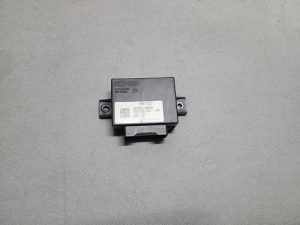
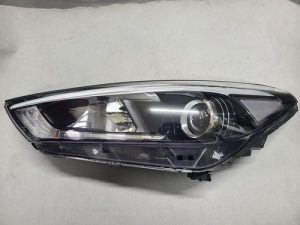
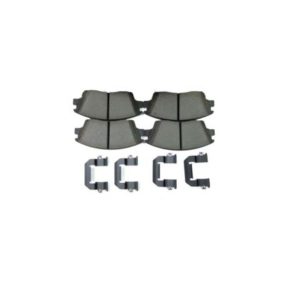
These are examples of listings where the exact vehicle matters. Compare the listing title and part number with your car, and send your VIN if anything is unclear.
How to use your VIN when you order
On new parts, the checkout has a VIN field. Fill it in with the full 17 characters. If you are unsure about a part, ask first through the quote request form and include the VIN there.
Used parts are quote-only, so a VIN helps even more. Send it with a photo of the old part and its number. Our page on how ordering works explains the steps from request to shipment.
Include this in your message:
- The full VIN, typed out, and a photo of the plate.
- The model name and the year you believe it is.
- The old part number, if you can read it.
- A photo of the old part from two angles.
- Your country, so import rules can be discussed.
Browse your model first. The Hyundai Tucson, Kia Sportage, Hyundai Grandeur and SsangYong Kyron hubs group parts by model, which narrows the search before you check the VIN.
If your car does not match a standard VIN
Some older cars, imports and rebuilt cars can carry plates that look unusual. If your number is shorter than 17 characters or has a different layout, do not force it into a form field. Type it exactly as printed and add a clear photo.
Tell us how the car reached you, for example whether it was imported from another country. That helps explain which market version you have. You can write through the contact page if the quote form does not fit your case.
Import duties and your own checks
The buyer pays import duties and taxes in the destination country. Rules differ between countries, so ask your customs agent before you order.
A VIN helps to match a part, but it is not a substitute for checking. Compare the new part with the old one before installation, and have a qualified mechanic fit it.
Common mistakes to avoid
- Copying the VIN from an old document without checking the car.
- Sending only the model name for an ECU or a headlight.
- Mixing up left and right headlights. Describe which side of the car you mean, and say whether it is driver side or passenger side.
- Skipping the old part number when it is readable.
A made-up example of the layout: KMH followed by fourteen more characters, 17 in total. It is only an illustration and not a real vehicle.
A VIN is a 17-character code: the first three characters name the maker, the middle block describes the vehicle, and the last block identifies your car. Send it with every quote request and fill it in at checkout, along with a photo and the old part number.